Updated on March 24, 2026
163+ Essential Recruitment Statistics to Know in 2026
Discover the latest job market trends with our competitive recruitment statistics - boost your job application now!


Novoresume got people hired at






















Finding a job can be a daunting task, especially if you consider the uncertainties of the current job market.
Job seekers face a range of new challenges, such as remote interviews and online application processes, as well as new benefits, including hybrid work arrangements and a greater focus on diversity and inclusion.
But with so many changes across the recruitment industry, it can be hard to keep up with the latest trends and statistics.
Understanding these changes is crucial for any job seeker’s career journey.
Recruitment statistics can help candidates make informed decisions, stand out to employers, and increase their odds of successfully landing their dream job.
In this article, we’ll take a look at the most essential recruitment statistics that job seekers need to know to succeed in 2026!
11 Key Recruitment Statistics
Recruitment trends are constantly evolving as companies adapt to changing labor markets, technology, and candidate expectations.
The statistics below highlight key insights into how organizations attract, evaluate, and hire talent today.
- Out of all Fortune 500 companies, 99% use an Applicant Tracking System (ATS).
- Over 70% of the employers that use ATS say it makes finding candidates easier.
- Hiring managers spend an average of 7 seconds looking at candidates' resumes.
- 41% of candidates use job search websites to find new career opportunities.
- On average, a job vacancy costs a company just under $100 per day.
- The first thing 70% of job seekers want to hear from a recruiter is what salary range they can expect.
- Two-thirds of professionals aren't actively seeking a job but would consider an offer.
- 50% of workers have declined a job offer due to a poor recruitment experience.
- Money remains the deciding factor for 67% of job seekers, and if recruiters aren't upfront with the salary range an employee can expect, they may lose out on potential hires.
- Almost 90% of job seekers will accept a job offer faster when a recruiter contacts them.
- On average, 55% of candidates believe a job offer should be made within two weeks of the first interview.
11 Statistics on Recruitment Trends
Recruitment is an ever-changing landscape, and the HR statistics and trends that come with it can be difficult to navigate.
Check out the statistics on recruitment trends we found to help you on your career journey:
- The job market is candidate-driven, according to an overwhelming 86% of recruiters.
- 62% of candidates agree they have the upper hand these days.
- In the workforce, 25% of millennials are often described as job hoppers.
- Nearly 50% of US employees want to look for a new job in 2026.
- Of those, 25% cite better career progression as their reason.
- Meanwhile, 21% cite looking for better compensation and benefits.
- Up to 75% of hiring managers say that candidates negotiate their salaries more often.
- Recruiters spend approximately 13 hours per week sourcing candidates for a single role.
- 41% of hiring managers report that entry-level positions are the hardest to fill.
- Email remains the most commonly used channel to reach candidates, at 51%, compared with other channels.
- And a further 39% of talent acquisition specialists believe it's the most effective.
15 Remote and Hybrid Recruitment Statistics
Remote work has revolutionized the hiring landscape and the way companies attract and retain top talent.
With the rise of remote work, candidates increasingly seek opportunities that allow them to work from home or offer greater flexibility.
From increased job satisfaction and productivity to expanded candidate pools, these remote work statistics shed light on the advantages of remote and hybrid recruitment:
- In recent years, virtual recruitment methods have become a key part of the hiring process.
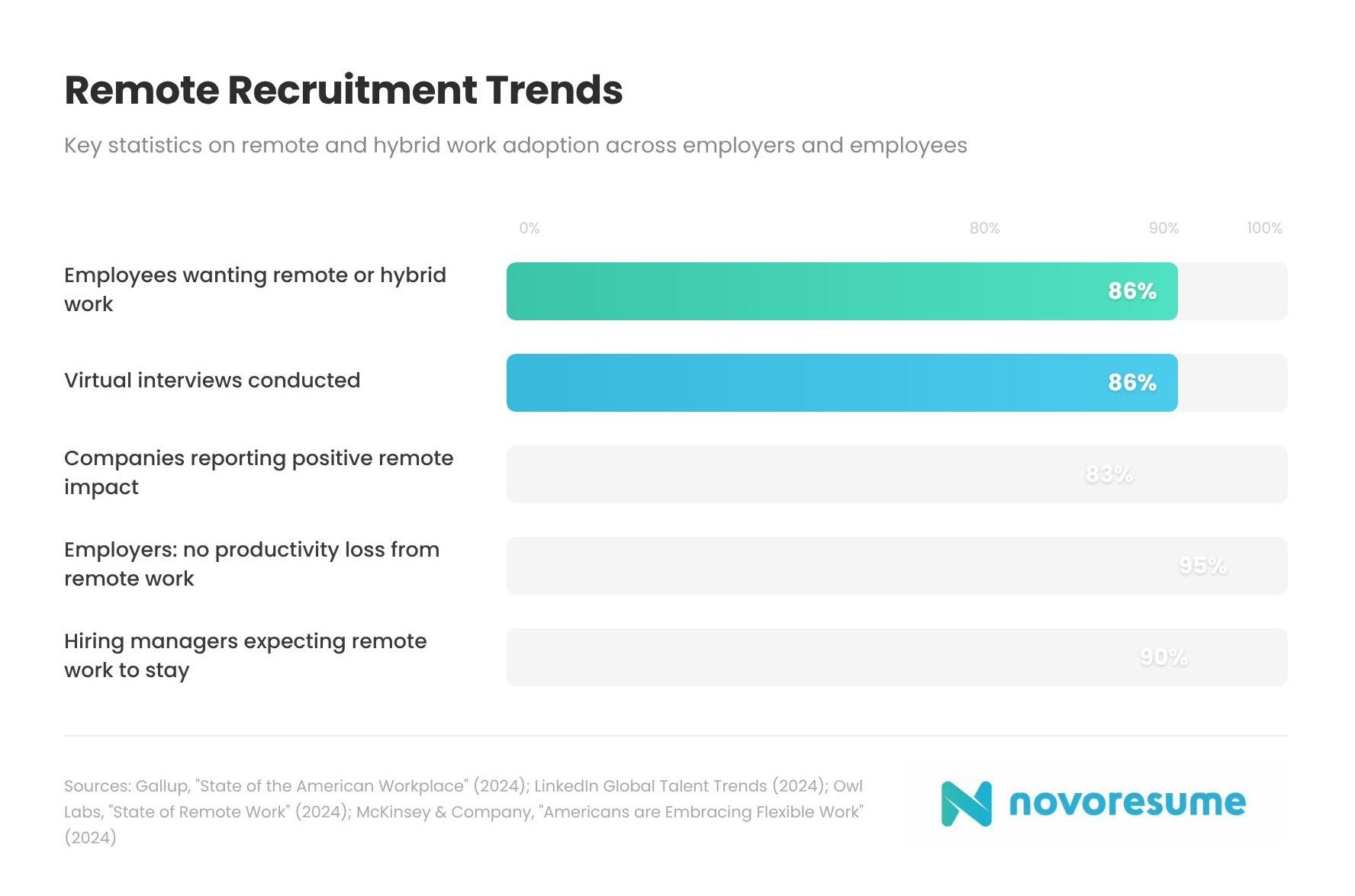
- To give you an idea, 61% of recruiters expect video interviews to replace face-to-face interviews completely.
- This makes sense, since about 86% of interviews are virtual.
- More than 86% of employees want to work remotely or in a hybrid arrangement.
- And it's not surprising, considering that another 83% of companies have found that remote work has positively impacted their flexibility, cost savings, and access to talent.
- A further 95% of employers report their productivity wasn't negatively affected while working remotely.
- 51% of respondents report increased productivity outside the office.
- 68% of hiring managers say that candidates often ask for work-from-home options.
- And 54% have had candidates turn down interviews or job offers due to a lack of remote work options or flexibility.
- Two-thirds of remote employees say they would return to on-site work if employers paid for their commute.
- Since 2019, remote job opportunities have increased by more than 135%.
- Remote workers have reported a 75 out of 100 Workforce Happiness Index score, while in-office employees reported 71.
- Approximately 66% of employers worldwide are redesigning their offices to support hybrid work models.
- Up to 90% of hiring managers expect remote work to keep being available in the future.
- And they might be onto something, as over 70% of companies planned to adopt the hybrid work model.
15 Diversity Hiring & Inclusion Statistics
Inclusive and equitable workplaces are built on diverse candidate sourcing.
Where diversity and inclusion go, increased profit, innovation, and employee retention follow. And the importance of DEI (Diversity, Equity, and Inclusion) efforts only goes up when companies want to attract top talent.
Check out the following statistics that highlight the importance of embracing diversity and fostering inclusive work environments for successful recruitment:
- In a poll of 1,300 full-time employees in the USA, an inclusive company culture was found to be crucial for finding and retaining talent.
- 76% of job seekers consider a diverse workforce an essential factor when evaluating companies and job offers.
- Diversity, equity, and inclusion are the top five priorities for HR leaders in 2026.
- 57% of employees believe their current company should be more diverse.
- Meanwhile, 37% would leave their current employer for a more inclusive employer.
- Over one-third of employers report that candidates expect to hear about a company's Diversity Equity and Inclusion (DEI) efforts, a record high.
- Diversity pays off for employers: companies with culturally diverse executive teams are 33% more likely to earn above-average profits.
- Racially diverse businesses are also 35% more likely to generally outperform their competitors.
- Diverse perspectives come naturally with a diverse group of employees, and the results speak for themselves. Companies with greater diversity are 70% more likely to expand their market presence.
- Companies that publicly embrace diversity and post about it on LinkedIn receive 26% more applications from women than companies that post less.
- While women are nearly 50% of the workforce, the gender wage gap remains at an average of 17% worldwide.
- Gender diversity has a long way to go, as men are twice as likely to get hired.
- Women are 46% more likely to get hired with a blind recruitment process that prevents unconscious bias.
- A 20% increase in geographical diversity is expected among applicants thanks to the rise of remote work.
- Diversity and inclusion in the workplace lead to creativity, innovation, better decision-making, and a vibrant workplace culture that enriches employees.
14 Onboarding Statistics
Whether a new hire is set up for success is often determined by the onboarding process they receive.
A well-designed onboarding process can ensure long-term engagement, productivity, and overall job satisfaction for employees.
We've found the following onboarding statistics to show you how job seekers and recruiters feel about onboarding:
- Communication and regular candidate engagement in the pre-onboarding process can improve the onboarding experience itself by 83%.
- A company's onboarding process can increase new-hire retention by over 80%.
- Smooth onboarding also boosts employee productivity by 70%.
- Workers who had a structured onboarding experience are nearly 60% more likely to stay with the company after three years.
- In contrast, bad onboarding experiences make new hires 50% more likely to look for another job.
- A whole 31% of new hires leave their new job within six months.
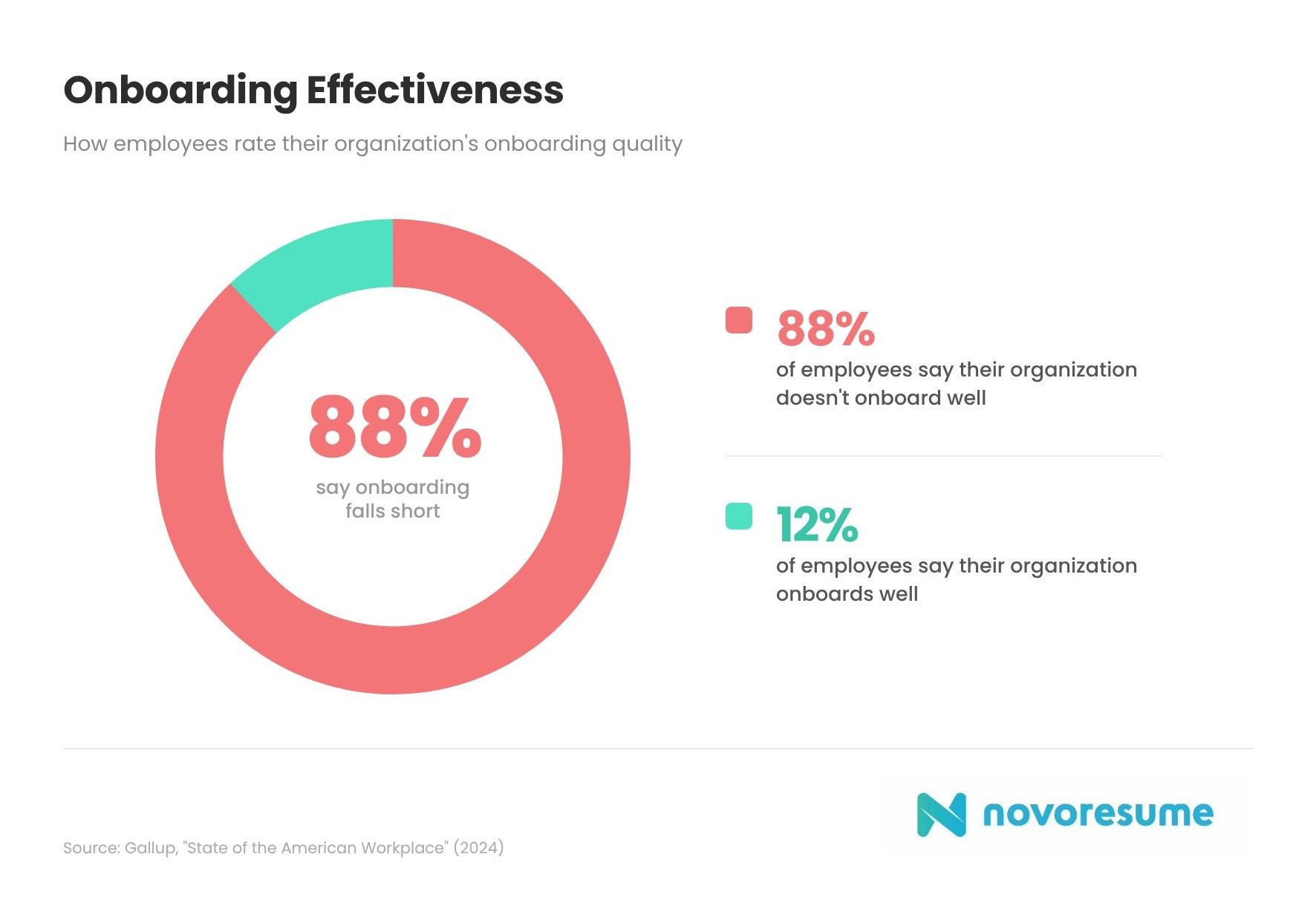
- 1 in 10 employees thinks their employer provides a good onboarding experience.
- In fact, 88% of employees say their organizations don't onboard effectively.
- Less than 29% of fresh hires feel prepared to thrive in their new role after onboarding.
- Onboarding is solely focused on paperwork for 58% of organizations.
- 62% of recruiters believe that in-person onboarding is more effective than virtual onboarding.
- Automating onboarding tasks can improve companies' employee retention rates by 16%.
- But 56% of new employees would prefer having a mentor, buddy, or other work coach to assist them.
- 54% of recruiters plan to combine remote and on-site onboarding.
13 Workplace Culture and Recruitment Statistics
Employees spend a third of their lives at work, so it's natural that they want a positive work environment that helps them thrive.
Additionally, hiring managers report that being a strong cultural fit is linked with increased employee satisfaction, lower turnover rates, and higher profits.
Here are the top workplace culture and recruitment statistics:
- The candidate's cultural fit accounts for 10% of the hiring decision, compared with 90% for skills and experience.
- One in five recruiters believes cultural fit is a determining factor in hiring decisions.
- Over 90% of recruiters have rejected candidates who were a poor cultural fit for the company.
- Company culture is key to retaining top talent: 70% of employees in the US say they wouldn't tolerate a poor workplace culture.
- 46% of job seekers report that company culture is an essential factor in their job search.
- Workplace culture is the leading reason for switching jobs, according to 25% of professionals.
- 15% of job seekers have turned down job offers due to the company's culture.
- Considering how important the work environment and cultural fit are, it's no surprise that satisfied employees are 12% more productive than the average worker.
- But less than 35% of workers in the USA receive weekly recognition for their work, so employers beware – undervalued employees are more likely to quit within their first year.
- Employees are 26% more likely to leave when there's no trust between coworkers.
- 88% of employers believe that a distinct, positive workplace culture is essential for productivity and profitability.
- Candidates these days prioritize work-life balance, mental health, and flexibility. 86% of workers believe flexibility would reduce their stress.
- A further 27% of candidates report they are seeking caring work environments.
10 Employer Branding and Recruitment Statistics
A candidate's first impression of an organization is often shaped by its reputation, so company branding and image are increasingly important in recruitment.
Employer branding can be a determining factor in attracting top talent and staying ahead of the competition in recruitment.
Take a look at some of the statistics that show the impact of employer branding:
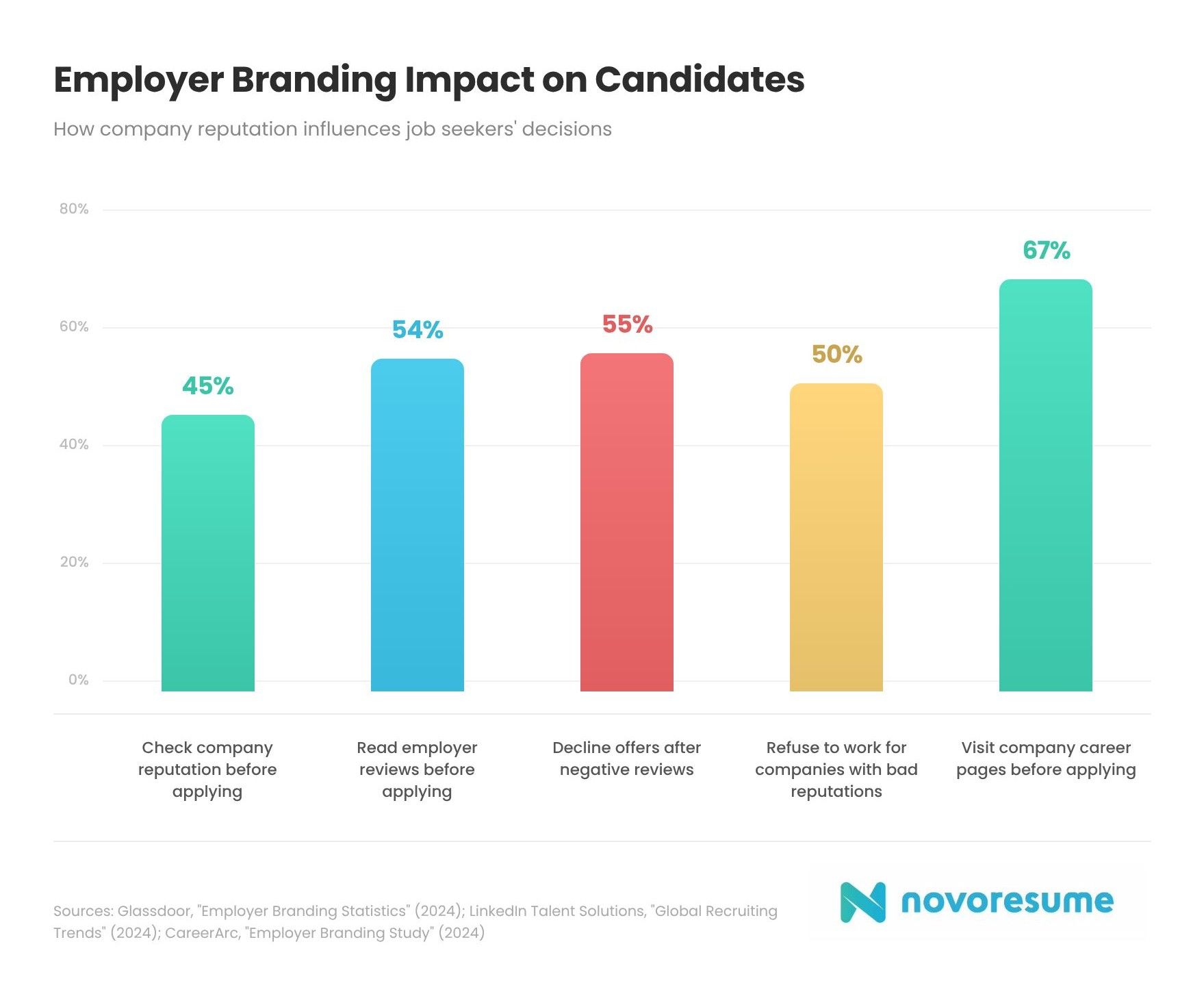
- About 45% of candidates research a company and check its online reputation before applying for a job with it.
- 54% of candidates read employer reviews before applying.
- In fact, employer reviews can be crucial, as another 55% of candidates decline job offers after reading negative reviews.
- And 50% of workers outright refuse to work for an organization with a poor reputation.
- Employee or leadership scandals can lead 33% of applicants to drop out of the recruitment process.
- Over 67% of candidates visit a company's official career pages before submitting an application.
- A further 68% of millennial candidates visit a company's website to evaluate the brand.
- Employers with strong brands attract nearly half of all qualified candidates.
- Recruitment costs can be reduced by 43% with strong company branding.
- Once candidates are hired, companies with strong brands improve employee retention by 28%.
10 Job Advertisement and Recruitment Statistics
While professional job boards appear to be losing popularity, job advertisements remain widely used across platforms.
Employers are changing their requirements for candidates, and job advertisements reflect it. The candidates themselves, on the other hand, are changing how they view job advertisements and what they're looking for.
See what the following statistics say about job advertisements and recruitment:
- Job listings are active for an average of 30 days.
- The most common soft skills listed in job ads are teamwork skills and problem-solving.
- Applications are increased by 34% when job ads include images or video testimonials.
- But over half of candidates complain about a lack of information on salary and benefits in job advertisements.
- Adding a salary to a job advertisement can increase candidates' interest by up to 75% on online job boards.
- An increasing number of job seekers consider mobile devices essential for job searching, with up to 89% viewing them as essential.
- With 45% of job seekers using their mobile devices at least once per day to search for new opportunities, employers need mobile-friendly ads and applications.
- The language used in a job advertisement, such as gendered or otherwise exclusionary language, can deter candidates from certain backgrounds.
- On average, 118 people apply for a single job advertisement.
- Of those, only 20% will be invited to an interview.
15 Social Media Recruitment Statistics
The digital age has brought rapid developments across all fields, but the most game-changing factor remains social media.
The labor landscape has shifted, and so have the ways people learn about job opportunities and cultivate their professional networks.
We've found the following social media recruitment statistics to illustrate just how crucial your digital footprint is:
- Social media is increasingly playing a larger role in recruitment: over 44% of recruiters use publicly available information from candidates' profiles to expedite recruitment.
- Around 35% of job seekers use professional networking websites.
- And a further 83% of companies use social media in their recruiting process.
- 86% of job seekers look for new opportunities through social media, with the majority of them being young workers in the first ten years of their careers.
- It's encouraging that 66% of recruiters post jobs on social media.
- Employers are 21% less likely to consider a candidate with no social media presence.
- Only about 45% of salaried executive or upper-management employees are hired through social media.
- 41% of employers won't interview a candidate if they can't find them online.
- Up to 54% of employers will reject applicants whose social media content doesn't align with their principles.
- For example, 20% of recruiters say seeing a candidate perform viral challenges on social media would negatively affect their hiring decision.
- Traditional job boards have become less effective than social media.
- Half of all professionals keep tabs on other companies' social media profiles to stay afloat of any employment opportunities.
- A considerable number of salaried employees are recruited through social media - upwards of 87% for non-management roles, and 82% for management.
- Recruiters looking for hourly wage employees score fewer candidates – about 55%.
- But LinkedIn is far ahead of other professional social media sites. Over 75% of workers who recently started a new job say LinkedIn had a pivotal role in their job hunt.
18 Statistics on Recruitment Challenges
Finding the right person for a vacant position can be challenging.
The job market is now candidate-driven, and potential hires often drop out of the application process before even reaching an interview.
Hiring managers face their fair share of challenges in today's job market, and understanding them can help you meet them halfway.
Take a look at the statistics on the biggest recruitment challenges we've found:
- Over 52% of recruiters consider reviewing resumes from a large pool of applicants the most challenging aspect of candidate screening.
- Finding candidates with particular skills is a challenge reported by more than 73% of recruiters.
- Hiring managers report that competitors hire over 85% of their potential candidates.
- Talent is hard to find, and top-tier candidates go off the market in less than two weeks.
- It takes companies an average of 42 days to fill vacancies.
- Traditional recruiting practices make it harder to find candidates, as about 70% of potential employees are passive candidates who aren't actively seeking new jobs.
- This means only 30% of potential hires are actively job hunting.
- Every 9 out of 10 employers are struggling to fill job vacancies.
- 29% of employers believe the skills gap has increased.
- The application process has drawbacks: more than half of candidates abandon online applications because they find them too complicated.
- 75% of recruiters have encountered candidates changing their minds before being hired.
- 44% of candidates drop the application process for companies that announce layoffs.
- First impressions matter – over 40% of candidates drop out of the recruitment process after a poor interaction with a hiring manager.
- But 39% of candidates decline a job because they received a better job offer elsewhere.
- Interviews remain daunting for employers as well. Over 83% of employees say that a bad interview experience can change their mind about a company they previously liked.
- Despite a thorough employee vetting process, nearly 75% of employers say they've hired an unsuitable candidate for certain positions.
- The cost of hiring the wrong candidate can be as high as $15,000 per bad hire.
- Companies should budget accordingly when hiring, as the average cost per hire in the USA exceeds $4,000.
20 Candidate Sourcing Statistics
Hiring managers overwhelmingly report that there's a talent shortage. So, how are HR experts sourcing their potential hires?
Ranging from professional networking, internal hires, and outbound resourcing, most methods can give you an idea of how to find your next job.
Here are the top statistics on candidate sourcing:
- 62% of hiring managers say that they find better candidates through outbound applications than by waiting for candidates to come to them.
- Employee referrals come out on top as the best method for high-performing candidates, according to 88% of businesses.
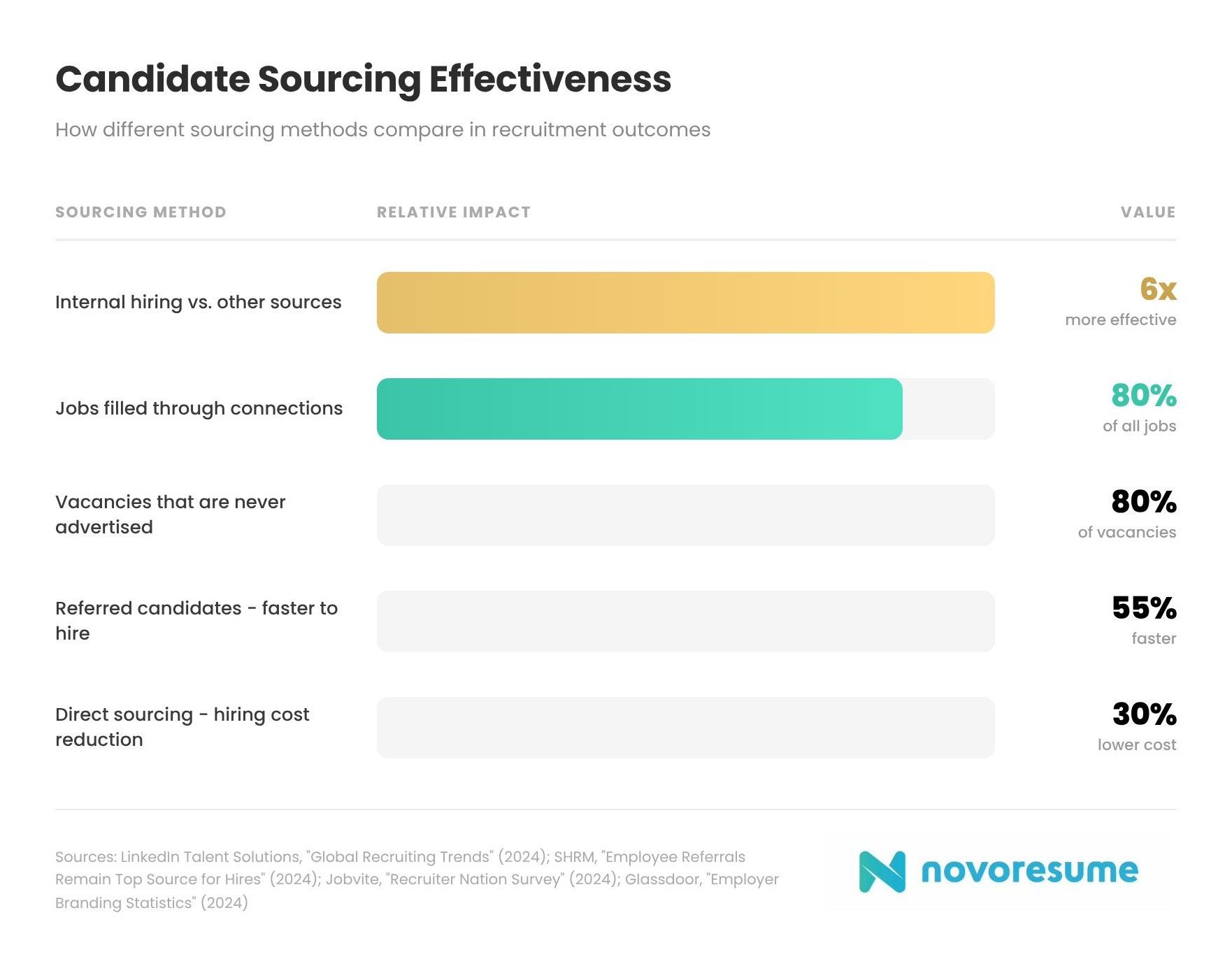
- Referred candidates are also over 55% faster to hire compared to other candidates.
- And potential candidates are 46% more likely to accept a job offer if they're referred by your current employees.
- Sourcing candidates through referrals applies to 65% of contingent workers as well.
- About 39% of employers that use contingent workers rely on direct sourcing for candidates.
- Direct sourcing reduces hiring costs by 30% because it's faster than using third-party headhunters.
- Third-party sources such as agencies, talent marketplaces, and consulting firms are rated the least important sources of candidates.
- Professional networking is a great way to source candidates, and companies that recruit through their employees' networks have a talent pool that's 10 times larger than competitors who don't.
- Over 67% of employees will refer candidates to help the applicant or the company.
- Fewer than 26% of employees will refer someone as a valuable coworker.
- And only 6% would do it for money or recognition at work.
- Nearly 50% hear about vacant job positions through word of mouth.
- Given all this, it's no surprise that nearly 80% of jobs are filled by professional and personal connections.
- And that 80% of vacancies are never advertised.
- Internal hiring is six times more effective than all other hiring sources.
- Around 36% of organizations lean on internal hiring.
- Nearly 70% of potential hires are open to learning about new opportunities but are hesitant to apply.
- And 87% say they would be open to new job opportunities if sought out by a recruiter.
- Technology should be used to its full potential, and according to 70% of survey respondents, automation in candidate sourcing would increase productivity across the board.
12 Top Trends on the Future of Recruitment
With the job market constantly changing, it's only fair to wonder what tomorrow will bring.
As technology advances, its role in recruitment grows, while traditional methods and candidate requirements become less important.
We've put together the top statistics on the future of recruitment trends to help you know what to expect:
- According to experts, nearly 22% of employees in the USA will work remotely.
- And millennials will make up 75% of the workforce.
- The trend shows that benefits are increasingly important, with over 79% of US employees seeking more than a salary increase today.
- 66% of candidates want to be kept informed during the hiring process.
- Direct sourcing is growing in popularity, with over 23% of companies planning to implement it in their hiring process.
- Over 67% of recruiters say that the best way to improve recruitment performance is to invest in new recruiting technology.
- And 70% of recruiters believe that the new standard is virtual recruitment.
- With 7 out of 10 companies struggling to find talent and 75% of employees admitting that they would be open to a job change if the right position was offered, recruitment is likely to be a growing industry in the coming years.
- 77% of professionals predict that diversity will be crucial to the future of recruitment.
- With 11% of companies already using AI technology to identify hard-to-reach candidate pools, it's likely to play a bigger role in recruiting in the years ahead.
- And 80% of executives believe AI can improve human resources performance.
- Over 50% of recruiters don't mind if a candidate's qualifications are earned online, rather than from a traditional institution, so expect an uptick in non-graduate workers ahead.
Conclusion
And those are our 164 recruitment statistics to help you land a job!
We hope you feel confident navigating the job market and understand current recruitment trends and future predictions.
Check out our career blog if you need any more information to help with your job hunt!
 Add Novorésumé as a preferred source on Google
Get more resume writing tips, career insights, and job search advice in your personalized Google search results.
Related posts

Job Interviews & Find A Job
Words and adjectives to describe yourself in interviews, on your resume, and in bios. Grouped by trait, with worked answers and the 10 words to avoid.

Job Interviews & Find A Job
100+ AI hiring statistics for 2026: employer adoption, AI resumes and cover letters, interview cheating, and detection rates, from our four 2026 surveys.

Job Interviews & Find A Job
90+ Gen Z workplace statistics for 2026: workforce share, the entry-level squeeze, AI, tenure, money, and the management myths. From 20+ primary sources.